


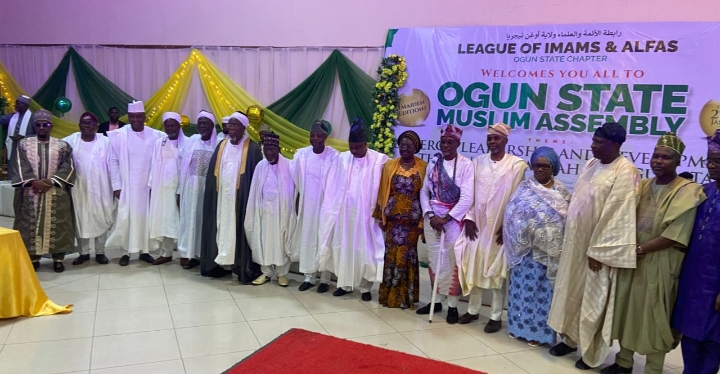
Muslims in Ogun State on Tuesday held their first-ever General Assembly in Abeokuta, calling for unity, inclusive leadership and institutional rebuilding to strengthen the Ummah and promote sustainable development.

The assembly, organised by the League of Imams and Alfas, Ogun State, with support from the Council of Muslim Titled Chiefs (COMTIC), attracted over 500 clerics, scholars, traditional rulers, politicians and community leaders.
The theme was “Synergy, Leadership and Development in the Muslim Ummah of Ogun State.”
Speaking through his representative, Prof. Abdulafeez Oladosu, the Registrar of the Joint Admissions and Matriculation Board (JAMB), Prof. Ishaq Oloyede, expressed concern over persistent disunity among Imams in the state, warning that internal divisions had weakened the collective strength of Muslims.
Declaring the assembly open, the Deputy Governor of Ogun State, Engr. Noimot Salako-Oyedele, stressed that spiritual authority must be supported by organisation, community ownership and collective participation to drive development.

She urged Islamic leaders to engage members beyond ceremonial activities, noting that governments respond more effectively to organised and united constituencies.
Former Governor of Ogun State and Senator, Ibikunle Amosun, described the gathering as timely, saying sectarian divisions had undermined the influence and public image of the Muslim Ummah.
He urged Muslims to prioritise shared faith and Qur’anic values over affiliations.
Earlier, the Secretary General of the League of Imams and Alfas, Ogun State, Sheikh Imam Tajudeen Adewunmi, said the assembly was convened to address challenges facing Muslims in education, healthcare, economic empowerment, leadership and social integration.
He said the diversity of participants reflected the belief that progress required broad consultation and shared responsibility.
Also speaking, the Baba Adeen of Yorubaland and former Nigerian High Commissioner to the UK, Alhaji Sharafadeen Tunji Ishola, emphasised that unity among Muslims would enhance tolerance and societal harmony.
In his keynote address, Emeritus Prof. Kamaldeen Balogun, Chief Imam of Gbagura-land and Mufti of Egba-land, attributed challenges facing the Ummah to internal fragmentation, leadership gaps, weak institutions and economic marginalisation.
He called for a structured consultative platform, a Muslim development blueprint, strengthened education through zakat and waqf, economic cooperation, inclusive leadership involving youth and women, and greater accountability.
The assembly, the first of its kind in Ogun State, was widely described as a potential turning point, with participants expressing optimism that the resolutions would translate into concrete actions for unity and sustainable development of the Muslim community.




