


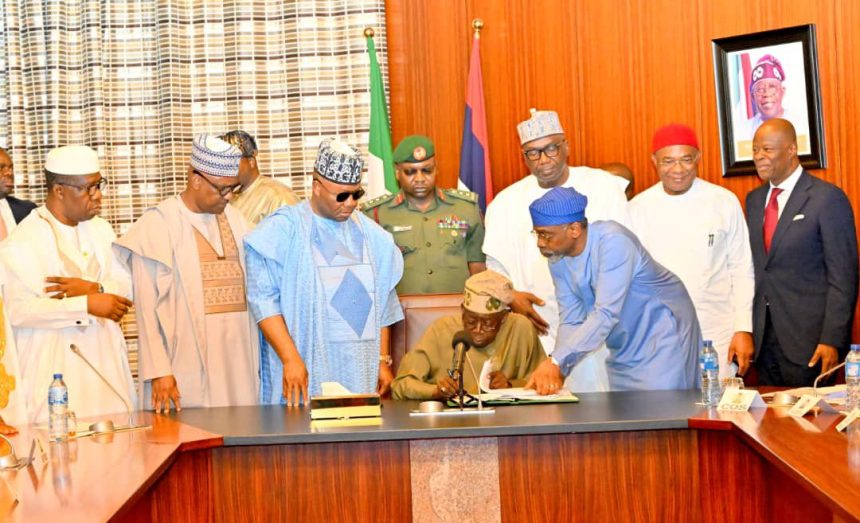
President Bola Tinubu has signed four tax reform bills into law, marking a significant overhaul of Nigeria’s fiscal and revenue framework. The bills, which have been a subject of much debate, were passed by the National Assembly after extensive consultations with various stakeholders. The new laws are set to take effect on January 1, 2026, providing a six-month transition period for preparation.
The bills signed into law include the Nigeria Tax Bill, the Nigeria Tax Administration Bill, the Nigeria Revenue Service (Establishment) Bill, and the Joint Revenue Board (Establishment) Bill. The Federal Inland Revenue Service (FIRS) will now be known as the Nigerian Revenue Service (NRS), as revealed by its Chairman, Zacch Adedeji.

The Nigeria Tax Bill aims to consolidate Nigeria’s fragmented tax laws into a harmonized statute, reducing the multiplicity of taxes and eliminating duplication. This is expected to enhance the ease of doing business, reduce taxpayer compliance burdens, and create a more predictable fiscal environment.
The Nigeria Tax Administration Bill establishes a uniform legal and operational framework for tax administration across federal, state, and local governments. The Nigeria Revenue Service (Establishment) Bill repeals the current Federal Inland Revenue Service Act and creates a more autonomous and performance-driven national revenue agency—the Nigeria Revenue Service. It also defines the NRS’s expanded mandate, including non-tax revenue collection, and lays out transparency, accountability, and efficiency mechanisms.
The Joint Revenue Board (Establishment) Bill provides for a formal governance structure to facilitate cooperation between revenue authorities at all levels of government. It introduces essential oversight mechanisms, including the establishment of a Tax Appeal Tribunal and an Office of the Tax Ombudsman.
Chairman of the Federal Inland Revenue Service (FIRS), Dr. Zacch Adedeji, and the Chairman of the Presidential Fiscal Policy and Tax Reforms Committee, Taiwo Oyedele, commended President Bola Tinubu’s bold leadership in signing the bills. Adedeji described the moment as “a dream come true” and hailed the President’s “vision, courage, and commitment” to modernizing the tax system.
Oyedele stressed that the reforms are pro-growth and pro-poor, aimed at improving equity, reducing burdens on vulnerable Nigerians, and stimulating economic development. He noted that over one-third of workers in both public and private sectors will now be completely exempt from Personal Income Tax, and more than 90% of micro, small, and nano enterprises are also exempt from Corporate Income Tax, VAT, and PAYE obligations.
Most significantly, Oyedele announced that essential goods and services, including food, healthcare, education, transportation, and accommodation, are now exempt from VAT, a move expected to lower the cost of living for millions of Nigerians. He added that the tax reforms are not about increasing tax rates, but about closing loopholes, simplifying processes, and expanding the tax base through digitalization.
House of Representatives member Hon. James Faleke and Senator Sani Mohammed praised the President’s courage, especially in the face of initial resistance. Faleke said the National Assembly had taken its time to consult widely and harmonize over 70 disparate taxes across federal, state, and local governments. Senator Sani Mohammed likened the reform to the removal of fuel subsidy, another tough but necessary decision by the Tinubu administration.
Both Adedeji and Oyedele acknowledged that implementation will be the real test, with Oyedele cautioning that “no matter how beautiful the law, it’s meaningless without proper execution.” He added, “Now is the time to move from legislation to action, and that will require a united effort from both public and private sectors.”




