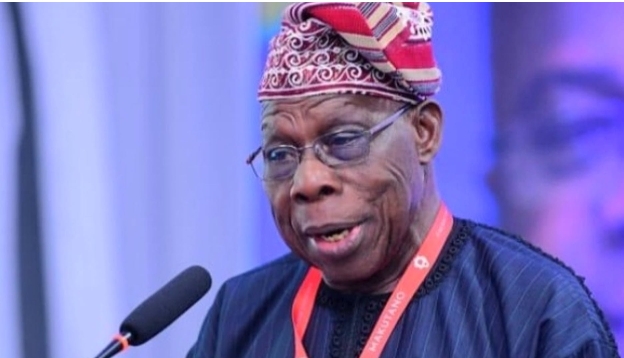
Former President, Chief Olusegun Obasanjo has disclosed that his imprisonment by late military junta, Gen. Sanni Abacha could be seen as evidence of the price that can accompany principled positions.
Obasanjo described leadership as both a heavy burden and a profound blessing, drawing from decades of military command, imprisonment, and democratic governance.

In a statement by his Special Assistant on Media, Kehinde Akinyemi, the former President stated in his keynote at an international colloquium titled: “Burden and Blessing of Leadership: Reflections from Global Africa to the World” held as part of activities to mark his 89th birthday ceremony in Abeokuta,Ogun State capital.
The elder statesman reflected on pivotal moments that shaped his understanding of power, responsibility and service.
Recalling his role as Commander of the Third Marine Commando Division during the Nigerian Civil War, Obasanjo said leadership often demands solitary decisions whose consequences affect millions. He noted that, in the final days of the war in 1970, he chose restraint in order to prevent further civilian casualties — a decision he said underscored the moral weight leaders must carry.
Obasanjo, who served as Nigeria’s military Head of State from 1976 to 1979 and later as civilian President from 1999 to 2007, said the public frequently underestimates the personal cost of leadership, citing his imprisonment under former military ruler Sani Abacha as evidence of the price that can accompany principled positions.
He also described leadership as a rare privilege — the opportunity to serve at defining historical moments, referencing Nigeria’s first peaceful transfer of power from military to civilian rule in 1979, when he handed over to President Shehu Shagari, as one of the most fulfilling decisions of his career.
On Africa’s development trajectory, Obasanjo argued that the continent’s enduring challenges “stem less from geography or history and more from governance failures. Africa, remains richly endowed with natural and human resources but continues to suffer from weak institutions, corruption and self-serving leadership.”
He called for deeper investment in leadership formation, institutional strengthening and democratic accountability, stressing that sustainable progress depends on systems that outlast individuals.
He also urged African governments to better engage the global African diaspora, describing it as an underutilised asset capable of accelerating continental renewal.
Highlighting continental integration efforts, the former President pointed to the African Continental Free Trade Area as a transformative initiative that could expand markets, attract investment and enhance Africa’s global competitiveness if fully implemented.

Obasanjo concluded with a message of gratitude and faith, reaffirming his belief in Africa’s long-term promise and urging the next generation to embrace accountable, service-driven leadership.
“Africa is not a problem to be managed,” he said. “Africa is a promise to be fulfilled — and leadership is how that promise gets kept.”
The 89th birthday ceremony is expected to be rounded up on Thursday, with a distinguished lecture on “The Global African Enlightenment from Chains to Renaissance ” to be delivered by Amb. Jean Robert Pillard, the Haitian Ambassador Extraordinary and Plenipotenciary to be followed by reception for guest at the OOPL, Abeokuta.