A major boost for regional trade and mobility emerged on Thursday as the South West Development Commission (SWDC) obtained a provisional rail operating and track access licence from the Nigerian Railway Corporation (NRC).
The approval allows the commission to begin running passenger and freight trains on existing rail lines across the six South-Western states, marking a shift from policy talk to on-ground implementation.

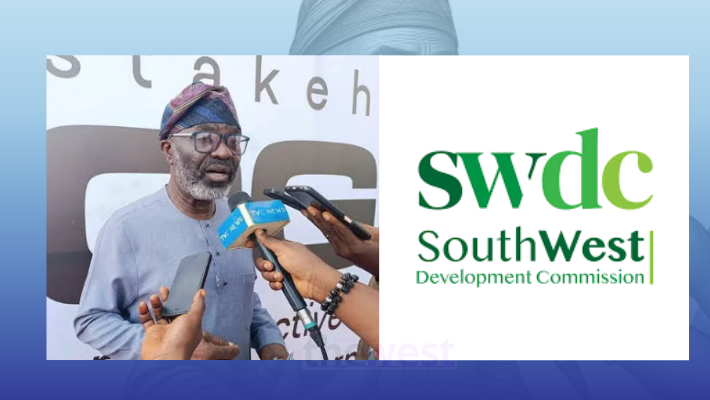
SWDC Managing Director, Charles Akinola, announced the development to journalists in Ibadan, describing it as a pivotal moment for the region’s economic integration.
He clarified that the licence does not involve building new tracks but rather operating services on both narrow and standard gauge networks already under NRC control. The initiative, named the South-West Rail, Agro-Industrial & Logistics Platform (SW-RAIL), is designed to tackle rising freight costs, road congestion, and supply chain inefficiencies.
“This licence is the green light to rebuild the South-West’s economic spine on rail,” Akinola said. “We are moving from plans to tracks, from talk to trains.”
The SW-RAIL platform will link ports, farms, factories, and cities across Lagos, Ogun, Oyo, Osun, Ondo and Ekiti. It integrates freight systems, cold-chain logistics, industrial parks, and passenger transport into a unified corridor.
Akinola noted that while the South-West remains Nigeria’s largest economic bloc, poor logistics continue to drive up business costs. He said rail offers a scalable and sustainable solution to reduce those inefficiencies.
The commission expects the rail service to lower logistics expenses, boost agricultural exports, create jobs, and ease pressure on major highways. Improved connectivity between Apapa and Tin Can ports and inland hubs is also a key target.
Akinola stressed that the model will be partnership-driven, welcoming private investors, state governments, and international infrastructure partners.
The rail initiative follows the recent launch of TransComs, another SWDC programme that turns rural communities into integrated economic clusters. Together, both schemes form part of a broader “One Bloc Economy” vision for the region.